Walk into almost any spare parts warehouse, and you will see the same pattern. Thousands, sometimes tens of thousands, of different parts. All labelled, all stored, all technically “important”. Yet treating every part in the same way is one of the fastest ways to create unnecessary costs or, worse, unexpected downtime. Part criticality is the method to help you avoid that trap. It separates the important from the less important parts. For supply chain and maintenance managers responsible for asset uptime, spare parts costs and service commitments, this separation is essential.

Why all spare parts should not be treated as equal

Spare parts environments are messy by nature. A single site can hold anything from cheap fasteners to highly specialised components for expensive assets. Applying one uniform inventory strategy across that entire range feels simple. It is also deeply inefficient.

Some parts have a disproportionate impact on operations. If they are unavailable, an asset stops. Production halts. Service levels collapse. Other parts, when missing, cause little more than a minor inconvenience or a workaround. When this difference is ignored, two things tend to happen: Either you overstock the non-critical parts, driving up spare parts costs and tying up working capital. Or you understock critical parts, significantly increasing the risk of backorders and asset downtime.

A structured approach to part criticality changes this dynamic. By explicitly differentiating parts by operational importance, you create a foundation for smarter inventory decisions. Critical parts get the attention they deserve; non-critical parts are managed with more flexibility. Criticality should become a key driver of inventory strategies rather than just a checkbox in the system.

What is part criticality in spare parts management

At its core, part criticality describes a part’s impact on operational continuity. In simple terms:

What happens if this part fails in the asset and it is not directly available for replacement?

  • Does a missing part stop an asset from running?
  • Does it reduce performance?
  • Does it trigger downtime?

These questions are essential, but they don’t make the full story.

In some industries, criticality is shaped by factors beyond pure operations. Another recurring factor is safety. Food and beverage companies must consider food safety; a small component may be cheap and easy to replace, yet critical because its failure could lead to contamination. Aerospace organisations operate under strict airworthiness requirements, while nuclear power plants have strict prevention measures to limit environmental risks.

There is also an after-sales dimension. For service organisations, contractual agreements with customers define what “critical” really means. Parts explicitly linked to service-level agreements or response-time commitments become critical by definition. Their unavailability directly translates into penalties, reputational damage, or lost contracts.

By contrast, non-critical parts have a lower operational impact. Their failure does not jeopardise safety or compliance, and they are not essential to fulfilling contractual obligations. Understanding this distinction is what allows you to manage different categories of spare parts in fundamentally different ways.

Key factors used to determine part criticality

Defining criticality requires structure. While every organisation will tailor the details to its context, most frameworks revolve around a consistent set of factors. Taken together, these factors create a multidimensional view of criticality. They move the discussion away from gut feeling and towards a shared, defensible assessment.

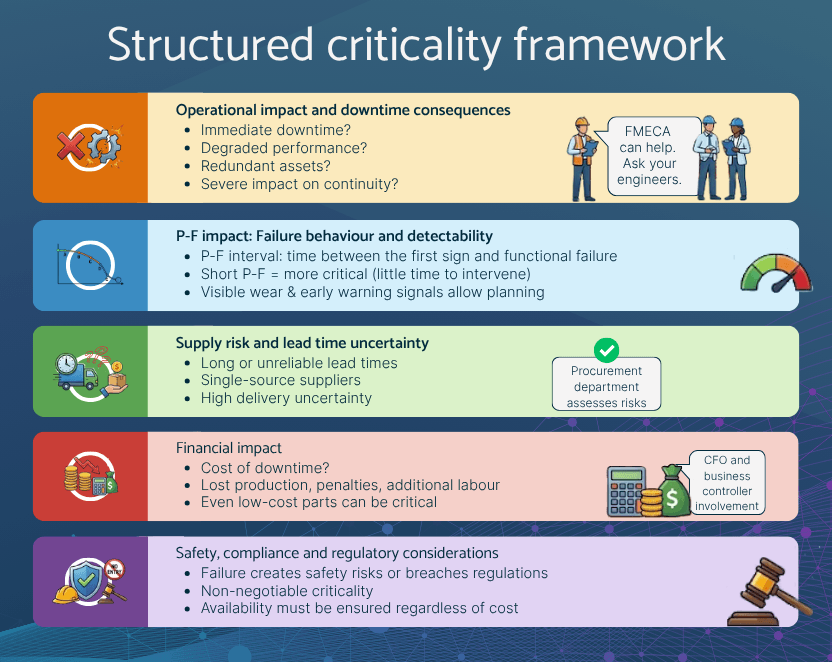
Operational impact and downtime consequences

This group examines what happens to the asset when a part fails or becomes unavailable. Does the failure lead to immediate downtime? Is asset performance degraded? Are there redundant assets? How severe is the impact on operational continuity? Typically, an FMECA (Failure Modes, Effects, and Criticality Analysis) can help answer these questions. Your engineers can tell you all about it.

PF-impact: failure behaviour and detectability

The PF-interval describes the window between the first detectable sign of degradation (Potential Failure) and actual functional failure. Parts with a short or non-existent PF interval are more critical because there is little opportunity to intervene. Others show visible wear, measurable degradation or early warning signals, allowing maintenance to plan and source replacements in advance.

Supply risk and lead time uncertainty

Criticality is also influenced by how difficult it is to replenish a part. Long or unreliable lead times, single-source suppliers, and high delivery uncertainty all increase the risk associated with unavailability. Your Procurement department assesses these risks.

Financial impact

Here, the focus shifts to money. What is the cost of downtime? How does unavailability translate into lost production, penalties or additional labour? Even a low-cost part can be critical if the financial impact of failure is high. The CFO and Business Controller come into play here.
Safety, compliance and regulatory considerations
Some parts are critical because failure creates safety risks or breaches regulatory requirements. In these cases, criticality is non-negotiable. Availability must be ensured regardless of cost or operational considerations.

 

Common challenges in defining critical parts

In theory, part criticality sounds straightforward. In practice, many organisations struggle to implement it consistently.

Often, parts are not classified at all. Or they are labelled as critical based on informal knowledge, historical incidents or individual opinions. Over time, these classifications become inconsistent and unreliable. What one team considers critical, another may ignore.

Subjective decision-making is a recurring problem. Without clear criteria, discussions turn into debates driven by experiences rather than data. This is especially challenging in environments with thousands of spare parts, where manual review of each item is simply infeasible.

The result is a criticality label that exists in the system but is not trusted. And when criticality is not trusted, it is not used to guide inventory strategies.

How structured criticality analysis supports spare parts optimisation

A structured approach to criticality is essential to overcome these challenges. It creates transparency, it enforces consistency, and it makes criticality actionable.

Where possible, the analysis should be largely data-driven. Asset hierarchies, failure data, lead times and cost information can all be used to assess criticality at scale. Expert input remains important, but it is applied selectively rather than across the entire catalogue.

This structure enables differentiated inventory strategies to be applied based on the criticality levels. Critical parts are managed with higher stock availability targets and tighter controls. Non-critical parts are optimised for cost efficiency. We often see that critical parts are managed with targets exceeding ~99% availability, while non-critical parts can be managed around ~90%. The outcome is a system that protects uptime and service commitments, while keeping spare parts costs under control.

Our advice

Start by accepting a simple truth: not every part deserves the same treatment. Applying a single stock availability level across all items is convenient, but rarely effective.

Review whether parts are classified today, and if so, how reliable that classification really is. Moreover, ask how criticality is used in inventory decisions, not just how it is defined. In the end, it is not about the criticality but the business impact you can achieve with that piece of information.

Finally, consider how a structured, data-driven criticality analysis could support more differentiated inventory strategies. Whether the goal is to reduce working capital, improve asset uptime, or strengthen service performance, part criticality is a powerful lever.

If you want to explore how to classify your parts more consistently or translate criticality into practical inventory strategies, a conversation with one of our experts is a good place to start.

Do you want to know more?

Would you like to contact us or learn more about our solutions and the author?

Wouter Heijnen