Supply Chain Strategy: From analysing the battlefield to plans of attack
A good strategist behaves like a fox: analysing the battlefield carefully and acting decisively. In spare parts management, strategy begins with understanding:
- the needs,
- the constraints, and
- the opportunities.
The needs include parts/goods maintenance needs, demand profiles and criticality profiles.
Common constraints are often financial in nature; for example, working capital may be limited. However, organisations also face operational constraints, such as limited storage capacity and resource availability. Other constraints are less visible and originate in the supplier market. The balance of power may not be in your favour, or suppliers holding stock may simply not be available locally, as is often the case in import-dependent countries such as Namibia.
At the same time, many opportunities may exist. These may be technological, such as the use of AI or 3D printing; commercial, such as providers offering spare parts management as a service; or collaborative. Even monopolistic OEMs (Original Equipment Manufacturers) can often provide a better service when forecast information is shared.
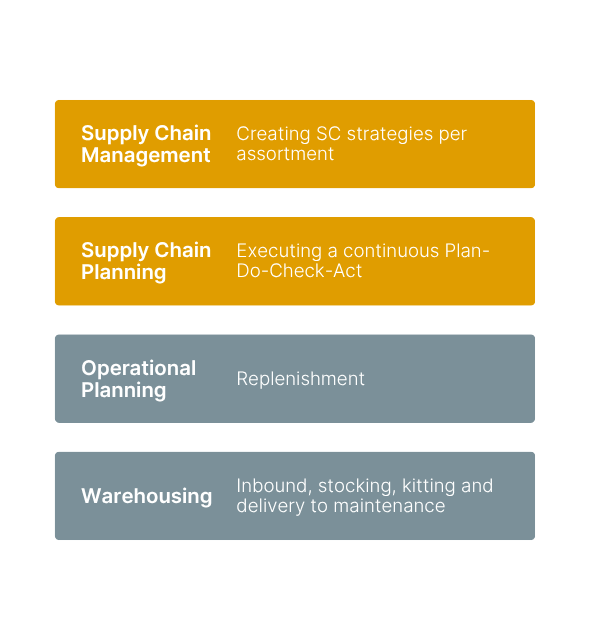
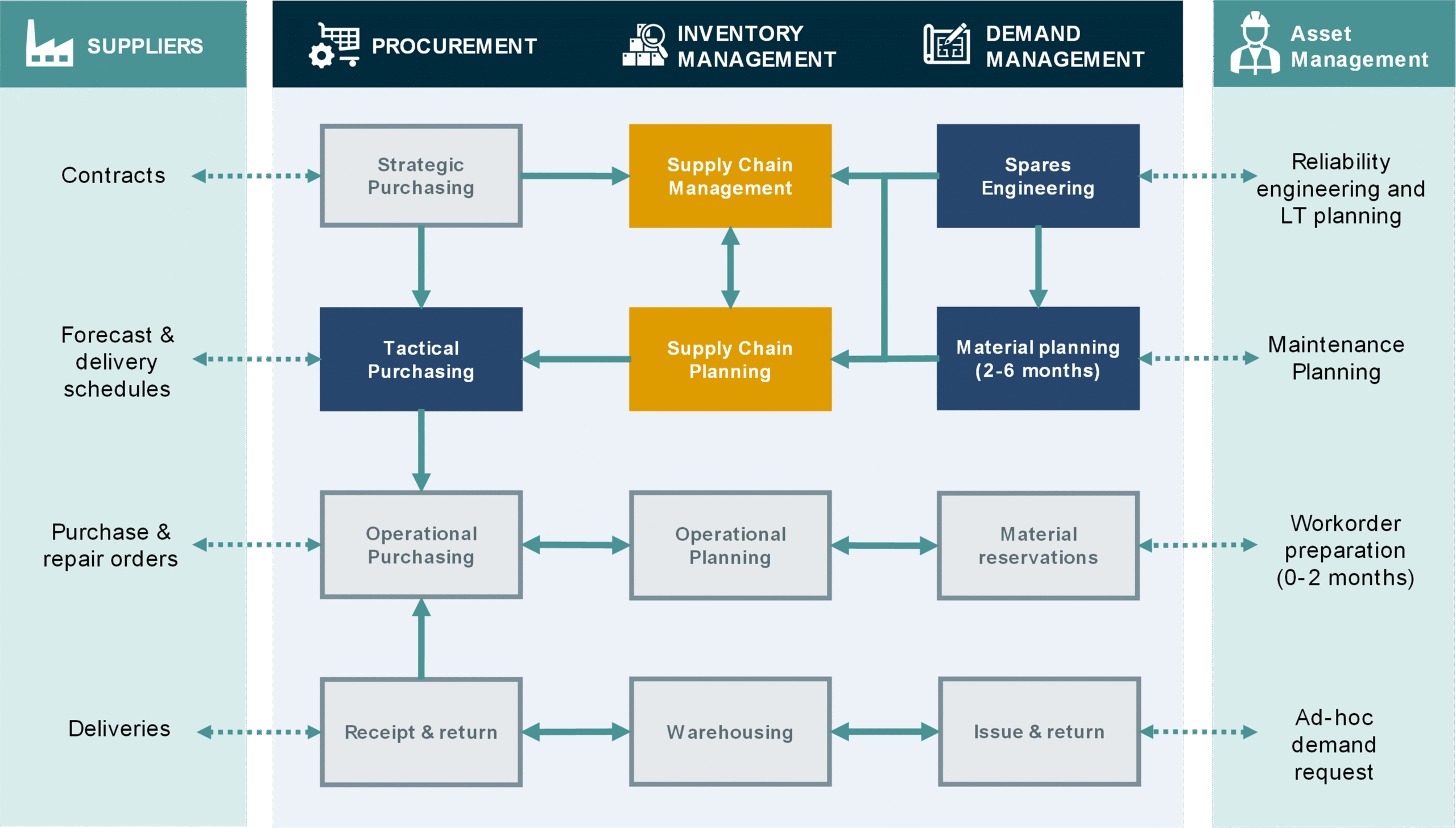
This comprehensive strategic analysis provides a structured overview of assortments, including critical and non-critical spare parts, consumables, rotables, and tools. For each assortment, “the bridge” is constructed by considering all the above factors. In practical terms, this bridge or supply chain strategy is defined by the maintenance requirement and the fulfilment method. An example of non-critical slow movers is shown below.

Supply Chain tactics: Continuously optimising the supply chain
In many organisations, tactical supply chain management is reduced to maintaining Min-Max inventory levels. Even then, adjustments are often reactive, with inventory parameters increased only after a painful stock-out occurs.
While this may solve short-term problems, it inevitably leads to growing working capital.
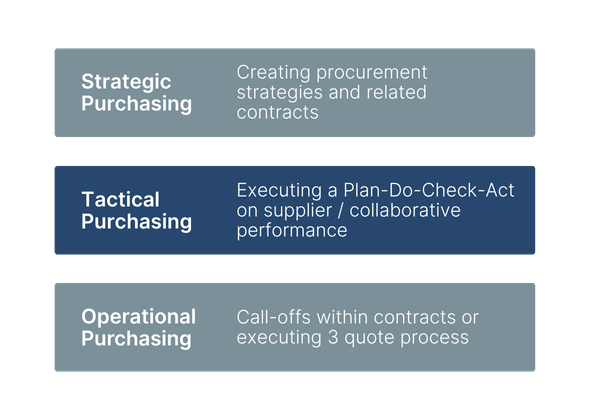
At its core, tactical supply chain management should operate according to a continuous Plan-Do-Check-Act (PDCA) cycle. See a brief explanation in the table below.
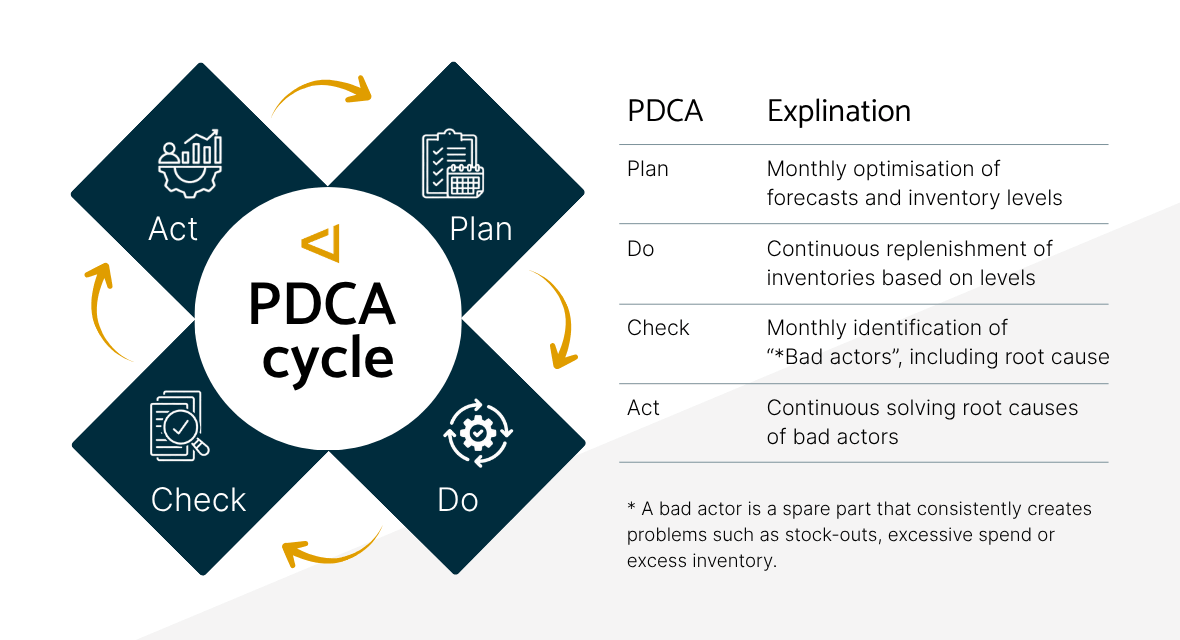
A PDCA is not a magic wand. This process cannot function effectively without digitisation. Spare parts environments often contain tens of thousands of parts or SKUs, making manual optimisation impossible.
Advanced forecasting and inventory optimisation tools, like Lanza, are therefore essential to enable:
- Accurate inventory settings
- Management by exception
- Automated replenishment
- Forecast-driven planning
Forecast information can also be shared with suppliers, improving their service capabilities and availability.
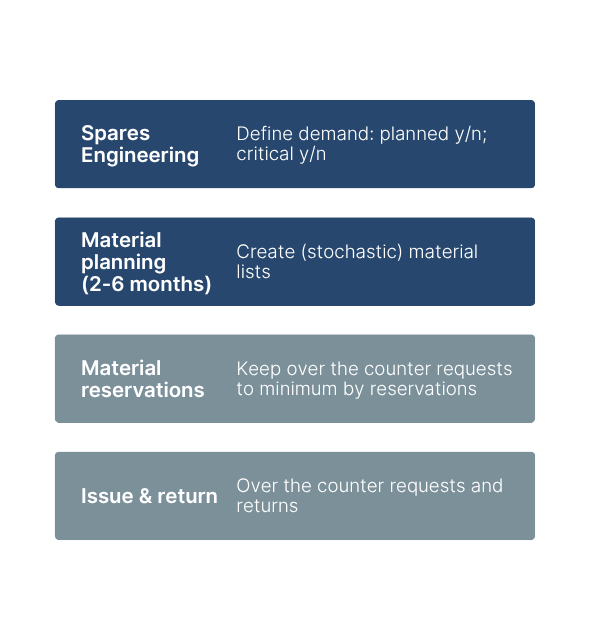
Conversely, supply chain teams can support maintenance planning through stochastic BoMs (probabilistic material lists), which typically require analytical capabilities and historical data not readily available within maintenance departments.
Supply Chain Operations: Becoming an Efficient Logistics Service Provider
This is where we meet the stores supervisor again, but ideally under much better circumstances. With proper planning and inventory optimisation:
- Replenishment becomes largely automated
- Inventory levels become more reliable
- Counter traffic decreases significantly
- Warehouse space utilisation improves
Inventory is primarily reserved for true breakdown demand. Planned maintenance materials are managed through cross-docking and work order kitting processes.
Ideally, the warehouse operates on a goods-to-person model, in which maintenance kits are proactively assembled and delivered to technicians.
As a result:
- Warehouse stress decreases
- Operational discipline improves
- Maintenance efficiency increases
Finally, peace and discipline are back in the store. See a summary below.