Step 1: Define service and business objectives
Every strategy starts with a clear definition of success. Determine the service levels that customers expect and the business is willing to support. If applicable, service-level agreements (SLAs), response-time commitments or uptime requirements should be used to set these targets.
If no explicit agreements exist, the desired service level often depends on the acceptable inventory investment. As there is always a trade-off, service goals and cost objectives should be defined together rather than independently.
Step 2: Segment your parts portfolio
Not every service part should be treated equally, as we discussed in our blog on criticality. Portfolio segmentation allows organisations to distinguish between different types of parts:
- Critical and non-critical parts
- Low-value and high-value parts
- Fast movers and slow movers
- Consumable and repairable parts
Per assortment, we should apply different inventory, replenishment, procurement and storage strategies. By differentiating the total parts portfolio, these strategies become more targeted and effective.
Step 3: Define aligned strategies
Once parts are grouped into assortments, tailored strategies and policies can be established.
A first step is to align service requirements with your inventory strategy. Parts that require quick response times and high availability should be delivered from stock (DFS) with a high availability target. In contrast, for other parts, a deliver-to-order (DTO) or lower stock availability target may suffice.
Next to the inventory strategy, the replenishment strategy dictates how inventory is replenished. Per the assortment, determine how to calculate the order quantity and review replenishments. For inexpensive parts, we might consider the economic order quantity (EOQ) and largely automating replenishment. For more expensive parts, lot-for-lot (one-piece) replenishment might be more suitable in service environments. If large investments are involved, it may also be appropriate to review replenishment processes or design an authorisation workflow.
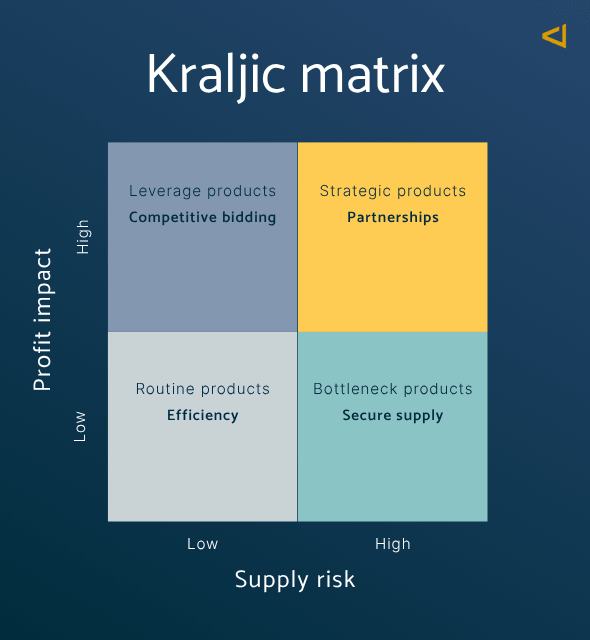
Related is the procurement strategy: for which assortments do we prioritise strategic supplier partnerships, contracts and framework agreements? Good contracts not only cover pricing but also facilitate supplier collaboration and account for lead times and service levels. What to focus on can be guided by Kraljic-type segmentation to determine appropriate supplier relationships for different assortments.
Step 4: Establish roles, governance and systems
Once all strategies are set up, it is important to assign roles & responsibilities. Service parts management sits at the intersection of multiple functions and departments. Effective governance ensures that roles and responsibilities are clearly assigned and that departments work together towards shared goals.
Moreover, technology has an important supporting role. ERP systems, planning tools and reporting tools are essential to turning your service parts strategies into success. The right systems provide decision support, visibility and relevant insights through data analytics. Shared information improves decision-making and strengthens alignment between departments.
Step 5: Monitor and continuously improve
Service parts management is not a one-time project. Performance should be continuously measured against the defined objectives and fine-tuned where necessary.
Dashboards help track key metrics such as stock availability, inventory value, service levels, forecast accuracy and supplier performance. However, measurement alone is insufficient. Organisations should translate performance insights into prioritised improvement actions. Bad-actor analysis can identify non-performing parts, recurring stock-outs, excess inventory or supplier bottlenecks. These insights form the basis for a structured service parts management roadmap and targeted improvement initiatives.